
Configuring Unified Pricing Rules (UPR) in Google Ad Manager Without Cannibalizing Fill Rate
In a unified first-price auction, setting a static floor price in Google Ad Manager (GAM) does far more than filter out low-value AdX bids: it establishes a

In a unified first-price auction, setting a static floor price in Google Ad Manager (GAM) does far more than filter out low-value AdX bids: it establishes a hard clearing threshold across every indirect and remnant demand channel competing for that impression. When an AdOps team raises a Unified Pricing Rule (UPR) by $0.50 without modeling the underlying bid density distribution, the immediate result is rarely a linear lift in clearing price. Instead, the rule truncates the left tail of the bid curve, triggers bid rejection spikes across both Open Bidding and Prebid Price Priority line items, and drives net revenue per thousand ad requests (rCPM) downward even as reported eCPM appears to climb.
This discrepancy between inflated eCPM and declining total yield is the classic signature of fill rate cannibalization. Because eCPM measures only the average price of filled impressions, discarding 30% of monetization volume at the bottom of the auction artificially boosts the average clearing price of the remaining 70% while leaving unmonetized ad requests on the table. In production environments handling hundreds of millions of daily requests across web, mobile app, and Connected TV (CTV) inventory, sustainable yield engineering requires optimizing for rCPM and session-level revenue rather than vanity eCPM metrics.
Preventing fill cannibalization requires a rigorous understanding of how GAM evaluates Unified Pricing Rules under the hood. AdOps architects must account for which line item priorities are governed by UPR, how GAM translates internal rule logic into outbound OpenRTB imp.bidfloor signals, why multi-size and brand-specific rules withhold floor data from DSPs, and how overlapping rules resolve when multiple targeting criteria match a single ad request.
How Unified Pricing Rules Apply Across AdX, Open Bidding, First Look, and Remnant Line Items
A common architectural failure in hybrid monetization stacks stems from treating Unified Pricing Rules as an AdX-only lever. According to the official Google Ad Manager Unified Pricing Rules specification, UPRs govern a broad spectrum of indirect and remnant demand sources simultaneously: AdX Open Auction, Open Bidding (formerly EBDA), First Look, Private Auctions, AdSense backfill, and non-guaranteed remnant line items including Price Priority (priority 12), Network (priority 12), and Bulk (priority 12). Only guaranteed delivery tiers (Sponsorship at priority 4 and Standard at priorities 6, 8, and 10) and Programmatic Direct deals (Programmatic Guaranteed and Preferred Deals) bypass UPR enforcement.
The inclusion of Price Priority, Network, and Bulk line items in UPR enforcement has direct architectural consequences for publishers running client-side Prebid.js or Prebid Server integrations. In a standard header bidding setup, winning bids from participating SSP partners are passed into GAM via key-value targeting (such as hb_pb=2.50) and matched against a granular grid of Price Priority line items. When GAM executes the unified auction, those Price Priority line items do not receive an automatic pass into the auction simply because their targeting keys matched on the page. Each eligible Price Priority line item must still clear the active Unified Pricing Rule floor assigned to that impression.
Consider a concrete production failure mode: a publisher configures client-side Prebid.js with a dynamic floor of $1.50 via the Prebid Price Floors Module, and a participating SSP returns a valid winning bid of $1.85. The browser passes hb_pb=1.80 (rounded to a $0.10 bucket) to GAM via Google Publisher Tag (GPT). However, if an AdOps manager has independently configured a GAM Unified Pricing Rule setting a $2.00 hard floor on that ad unit, GAM disqualifies the $1.80 Price Priority line item before final auction resolution. Even worse, if no AdX or Open Bidding buyer bids above $2.00, the impression goes completely unfilled (or collapses to a house ad), destroying $1.80 of verified, auction-ready header bidding demand.
To prevent GAM from rejecting valid header bidding wins, publishers operating on our unified monetization platform synchronize floor definitions across the entire supply path. If a floor is enforced in GAM via UPR, it must either be mirrored in the Prebid Price Floors configuration so SSPs receive accurate bidfloor signals upfront, or the Price Priority line items must utilize Value CPM adjustments cautiously so they are never unintentionally filtered out after winning the wrapper auction. Furthermore, when Private Auctions are active on an inventory slice, AdOps teams must verify that the UPR floor does not exceed the negotiated Private Auction deal floor; otherwise, the overarching UPR will silently block deal bids that cleared the negotiated private threshold but fell short of the broader rule.
What Floor Signals Are Actually Sent to Buyers in Bid Requests
When Google Ad Manager constructs an outbound OpenRTB 2.6 bid request for AdX buyers and Open Bidding partners, it communicates the minimum acceptable bid through the bidfloor and bidfloorcur attributes inside each Imp object. Downstream DSPs rely heavily on this explicit imp.bidfloor value for two critical functions: QPS throttling (deciding whether a campaign's maximum CPM can realistically compete for the impression) and first-price bid shading (calculating the lowest possible bid that still maintains a high probability of winning the auction).
{
  "id": "8f92a1c4-71b0-44e2-991a-0034bc819e21",
  "imp": [
    {
      "id": "1",
      "banner": {
        "format": [
          { "w": 300, "h": 250 },
          { "w": 300, "h": 600 },
          { "w": 320, "h": 50 }
        ],
        "pos": 1
      },
      "bidfloor": 0.45,
      "bidfloorcur": "USD",
      "secure": 1
    }
  ],
  "site": {
    "domain": "publisher-example.com",
    "page": "https://publisher-example.com/finance/markets"
  },
  "tmax": 120
}
However, GAM does not always transmit the exact floor configured in the GAM UI inside the outbound imp.bidfloor field. There is an intentional architectural separation between pre-auction floor signaling (what buyers see in the OpenRTB bid stream) and post-response auction enforcement (the threshold GAM applies when evaluating returned bids). Understanding this asymmetry is essential because whenever GAM holds a floor back from the bid request, DSP bid-shading algorithms operate blind to the true clearing threshold.
Why Brand-Specific, Size-Specific, and Skippable Floors Are Held Back from the Bid Request
Inside a Unified Pricing Rule, GAM allows publishers to configure granular sub-allocations: you can set different floors for specific advertisers or brands, distinct floors for individual creative sizes, or divergent floors for skippable versus non-skippable video inventory. While these granular controls appear straightforward in the GAM interface, GAM withholds brand-specific, size-specific, and skippable floor values from the outbound OpenRTB imp.bidfloor parameter, enforcing them strictly during internal auction resolution after bids are returned.
The engineering rationale behind withholding these floors is rooted in the protocol timing of OpenRTB. When GAM emits a bid request, it has no way of knowing which advertiser domain (adomain) a DSP will select, which specific creative dimensions from a multi-size array the buyer will return, or whether a video DSP will respond with a skippable or non-skippable VAST 4.3 payload. If GAM transmitted a $5.00 brand-specific floor (intended only for a single luxury automotive advertiser) as the global imp.bidfloor on the request, every other advertiser bidding between $1.00 and $4.99 would read the $5.00 floor and withhold their bids entirely.
Instead, GAM sends the baseline anonymous floor (or $0.00 if no general floor exists) in the bid request and applies the higher brand-specific, size-specific, or skippable floor as a post-bid filter. In practice, this creates a severe bid-shading trap:
- A DSP receives a bid request showing
imp.bidfloor: 0.80. - The DSP's machine learning bidder values the user at $3.20 for a specific retail brand, but because the visible floor is $0.80 and historical clearing prices on that placement hover around $1.40, its bid-shading algorithm shades the bid down to $1.55.
- GAM receives the $1.55 bid, inspects the declared advertiser mapping, identifies a hidden brand-specific UPR floor of $2.25 for that retailer, and rejects the bid.
Because the buyer never saw the $2.25 floor in the bid stream, the DSP had no signal to relax its bid-shading ratio. When brand-specific or size-specific rules are overused, publishers experience high volumes of silent bid rejections logged under the Filtered by publisher pricing rule status without ever training buyer algorithms to bid higher.
Multi-Size Requests: Why Buyers See Only the Lowest Eligible Size Floor
A closely related signaling bottleneck occurs on multi-size ad requests. To maximize bidder competition, publishers frequently configure a single GPT ad slot to accept multiple IAB standard sizes: for example, combining a high-impact 300x600 half-page unit, a standard 300x250 medium rectangle, and a compact 300x50 or 320x50 banner within the same googletag.defineSlot() call.
When a multi-size request is evaluated against Unified Pricing Rules, GAM determines all eligible creative sizes requested by the slot, checks the applicable floors across those sizes, and sends buyers only the lowest floor price among the eligible sizes in the outbound bid request. If a slot requests 300x600 (configured with a $4.00 floor), 300x250 ($1.50 floor), and 320x50 ($0.35 floor), every DSP receiving that multi-size bid request sees imp.bidfloor: 0.35.
This lowest-common-denominator signaling degrades yield in two ways. First, buyers bidding on the 300x600 or 300x250 creative formats anchor their bid-shading models to the $0.35 visible floor, causing a large percentage of their shaded bids to fail the hidden size-specific floors during auction enforcement. Second, if the publisher did not configure explicit size-level sub-rules and instead relied on separate size-targeted UPRs, a buyer can win a high-viewability above-the-fold placement with a $0.40 320x50 creative, cannibalizing inventory that would have cleared at $2.80+ had the request been restricted to high-impact sizes.
To eliminate multi-size floor dilution, AdOps engineers should decouple low-value micro-banners from high-impact placements using responsive GPT sizeMapping rules and pass explicit slot profile key-values into GAM so each viewport tier maps cleanly to an unambiguous UPR:
window.googletag = window.googletag || { cmd: [] };

googletag.cmd.push(function() {
  // Separate high-impact desktop sizes from mobile banner sizes via sizeMapping
  const rightRailMapping = googletag.sizeMapping()
    .addSize([1024, 768], [[300, 600], [300, 250]])
    .addSize([768, 480], [[300, 250]])
    .addSize([0, 0], []) // Suppress right-rail slot on mobile viewports
    .build();

  const rightRailSlot = googletag.defineSlot(
    '/21800000000/finance_desktop_right_rail',
    [[300, 600], [300, 250]],
    'div-gpt-ad-right-rail-1'
  )
  .defineSizeMapping(rightRailMapping)
  .setTargeting('slot_profile', 'high_impact_rail')
  .addService(googletag.pubads());

  googletag.pubads().enableSingleRequest();
  googletag.enableServices();
});
By removing the 320x50 size from the desktop and tablet size map and isolating high-impact dimensions, the lowest eligible size floor on desktop becomes the 300x250 floor rather than a sub-dollar mobile banner floor.
Target CPM vs. Hard Floor CPM Mechanics in UPR
When defining pricing inside a Unified Pricing Rule, Google Ad Manager provides two distinct enforcement mechanisms: Hard Floor CPM (fixed floor) and Target CPM. Selecting the wrong mechanism for a given traffic segment is the single fastest way to collapse fill rates. A Hard Floor CPM acts as an absolute binary gate: every single bid response (and remnant line item) below the specified dollar figure is summarily rejected, regardless of time of day, user session depth, or real-time buyer bid density.
Target CPM, by contrast, instructs GAM's auction engine to dynamically modulate the per-impression floor sent to buyers across individual requests so that the average winning clearing price across the rule's traffic matches or exceeds the specified Target CPM. When a user with high third-party or first-party audience affinity loads a page during peak daytime hours, GAM scales the outbound imp.bidfloor above the Target CPM to capture buyer surplus. Conversely, when a user with no identifier loads a page at 3:00 AM local time or reaches the 12th pageview of a deep session where buyer frequency caps are exhausted, GAM scales the per-impression floor below the Target CPM so lower bids can still clear, preserving fill rate while maintaining the target average across the aggregate distribution.
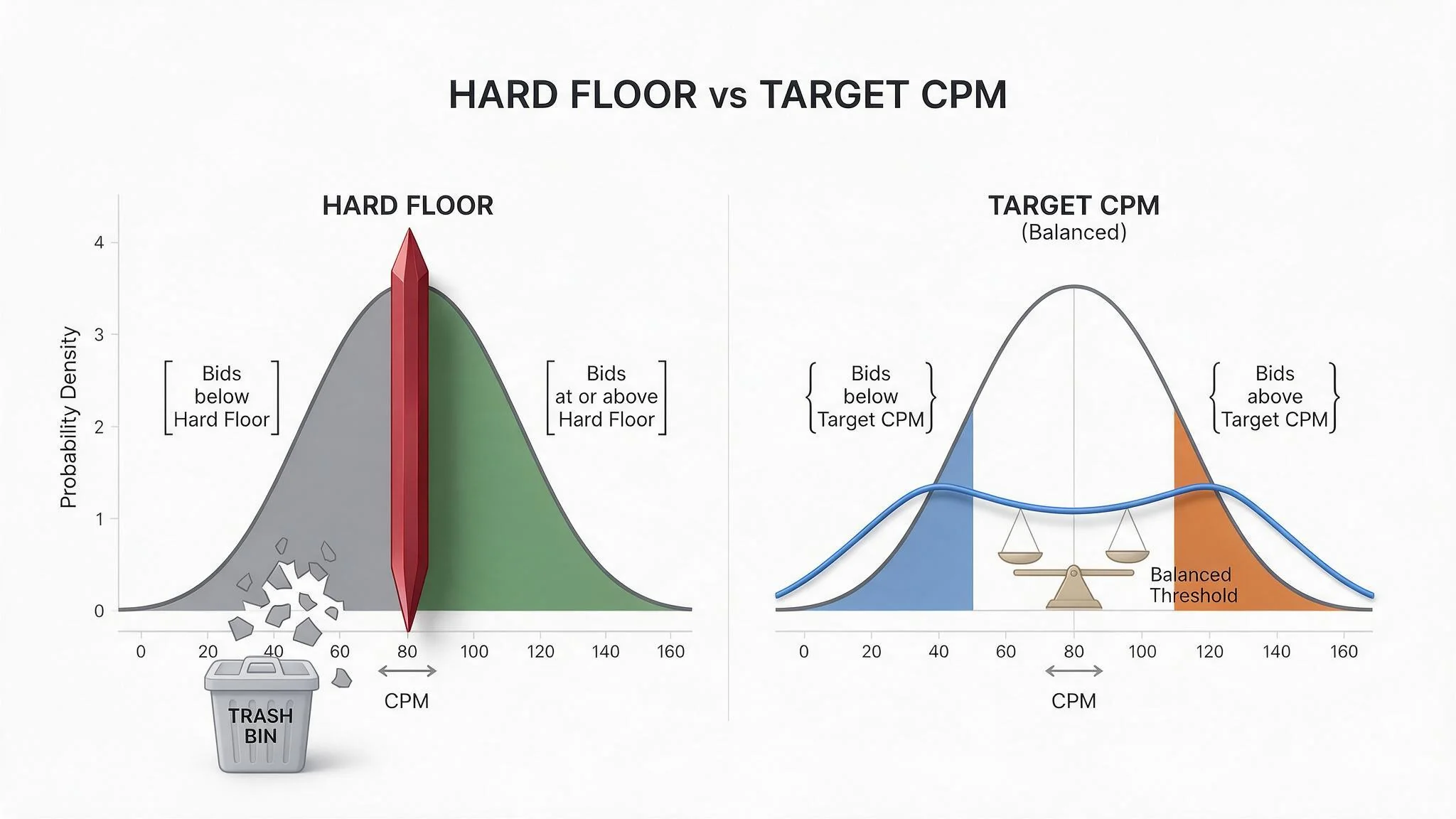
From a statistical standpoint, programmatic bid responses for any given ad unit follow a right-skewed log-normal distribution. Placing a Hard Floor CPM near the median of that distribution amputates the entire left half of the curve, turning every low-density impression into an unfilled request. Before locking in a hard floor vs. a Target CPM rule, yield teams should benchmark their baseline clearing curve and run sensitivity checks to verify that the projected eCPM lift on surviving impressions mathematically outweighs the revenue lost from dropped fill. The governing metric must always be rCPM:
$$\text{rCPM} = \left( \frac{\text{Total Programmatic Revenue}}{\text{Total Eligible Ad Requests}} \right) \times 1000 = \text{eCPM} \times \text{Fill Rate}$$
If raising a Hard Floor CPM from $1.00 to $1.60 increases filled eCPM by 18% (to $1.88) but drops fill rate from 82% to 61%, the effective rCPM falls from $1.31 to $1.15, resulting in a 12.2% net revenue loss.
Despite its advantages for preserving fill rate, Target CPM is not a universal replacement for hard floors. Target CPM requires statistical scale to converge accurately; on niche ad units or hyper-segmented rules receiving fewer than 50,000 impressions per day, the dynamic algorithm lacks sufficient conversion feedback and can oscillate erratically. Additionally, because Target CPM dynamically lowers per-request floors on low-demand impressions, publishers with strict brand-safety or minimum margin requirements on high-cost infrastructure (such as Server-Side Ad Insertion / SSAI stitched CTV streams where ad serving and mezzanine transcoding carry fixed per-impression delivery costs) should deploy a hybrid structure: use a conservative Hard Floor CPM to cover baseline infrastructure and minimum inventory valuation, and layer Target CPM rules on high-volume web and mobile app placements where maximizing rCPM across variable bid density is the primary objective.
Granular Rule Segmentation and Rule Overlap Resolution (Highest Floor Wins)
Google Ad Manager permits up to 200 active Unified Pricing Rules per network. Unlike legacy waterfall configurations where the ad server evaluated rules top-to-bottom and stopped at the first match, GAM evaluates every active Unified Pricing Rule that matches an incoming ad request's targeting criteria. When two or more rules match the same impression, GAM resolves the conflict using a strict deterministic rule: the highest floor price wins.
Consider how this "Highest Floor Wins" logic creates compounding yield failures in complex networks. Suppose an AdOps team maintains three seemingly independent sets of Unified Pricing Rules:
- Rule A (Geography Baseline): Targets
Geography = United States, setting a Target CPM of $1.20 across the network. - Rule B (Viewability Tier): Targets custom key-value
vw_bucket = 70_plus(placements with >70% historical Active View viewability), setting a Hard Floor CPM of $2.40. - Rule C (Seasonal Audience Campaign): Targets
First-Party Audience = Finance Intenders, created during Q4 with a Hard Floor CPM of $4.50 and accidentally left active across all devices in Q1.
When a US user in the Finance Intenders segment visits a mobile web article during an off-peak weekend hour, all three rules match the request. Because max($1.20, $2.40, $4.50) = $4.50, GAM enforces the $4.50 Hard Floor CPM on a standard mobile web banner that normally clears at $1.35. Even though Rule A was configured as a flexible Target CPM, the overlapping $4.50 Hard Floor from Rule C overrides it completely, causing the fill rate on that user cohort to plummet.
To eliminate unintentional rule collisions, publishers utilizing our enterprise publisher solutions enforce an orthogonal UPR taxonomy. Rather than creating overlapping rules across mixed dimensions (some by geography, some by audience, some by ad unit, some by device), an orthogonal architecture partitions rules into mutually exclusive cohorts driven by a deterministic key-value or ad unit hierarchy:
- Tier 1: Global Safety Net (1-5 Rules): Broad network-wide rules segmented strictly by Device Category (CTV, Desktop, Tablet, High-End Mobile, Low-End Mobile) with low Hard Floors ($0.10-$0.50 on web, $3.00-$5.00 on CTV) designed solely to block sub-penny malware or arbitrage bids without restricting legitimate DSP bid shading.
- Tier 2: Core Yield Matrix (20-80 Rules): Segmented by
Geo Tier x Placement Viewability Tier x Deviceusing Target CPM. Because every impression falls into exactly one Geo Tier, one Viewability Tier (vw_high,vw_mid,vw_low), and one Device Category, two rules within Tier 2 can never overlap on the same request. - Tier 3: Surgical Exception Rules (Time-Boxed): High-floor rules for specific seasonal events or premium sponsorships that explicitly exclude off-peak inventory or mobile web placements via negative targeting.
-- BigQuery GAM Data Transfer query to detect UPR floor cannibalization
-- Compares unfilled back-end requests against active rule changes by Ad Unit and Device
SELECT
  DATE( TIMESTAMP_MICROS(time_usec) ) AS event_date,
  ad_unit_id,
  device_category,
  COUNT(CASE WHEN line_item_id = 0 THEN 1 END) AS unfilled_impressions,
  COUNT(*) AS total_code_served,
  ROUND(
    SAFE_DIVIDE(
      COUNT(*) - COUNT(CASE WHEN line_item_id = 0 THEN 1 END),
      COUNT(*)
    ) * 100, 2
  ) AS fill_rate_pct
FROM
  `publisher_gam_dt.NetworkBackfillImpressions_21800000`
WHERE
  _PARTITIONDATE >= DATE_SUB(CURRENT_DATE(), INTERVAL 14 DAY)
GROUP BY
  1, 2, 3
HAVING
  total_code_served > 10000
ORDER BY
  event_date DESC, unfilled_impressions DESC;
Engineering teams should pair this orthogonal rule structure with automated daily diagnostics in GAM Historical and Ad Exchange reporting. Specifically, pull the Bid rejection reason dimension weekly and track the percentage of total bid responses categorized under Filtered by publisher pricing rule alongside Outbid. In a healthy first-price auction configuration, Filtered by publisher pricing rule should remain below 8% to 12% of total gross bid volume. Whenever that rejection metric spikes above 15% on a placement while overall rCPM stagnates or drops, an overlapping Hard Floor rule or a multi-size/brand-specific signaling mismatch is actively choking off viable demand, and the offending rule should be converted to Target CPM or re-anchored to the 15th-25th percentile of the placement's natural clearing price distribution.