
Diagnosing and Fixing Blank Ads: Mixed Content Blocking, Creative Rendering Failures, and TTL Expiration
When Google Publisher Tag (GPT) dispatches googletag.events.SlotRenderEndedEvent with event.isEmpty set to false, the ad server is only confirming that a

When Google Publisher Tag (GPT) dispatches googletag.events.SlotRenderEndedEvent with event.isEmpty set to false, the ad server is only confirming that a line item won the auction and its top-level creative wrapper was injected into the slot container. That event does not verify that a single visual pixel was painted to the screen. Across complex header bidding stacks running Prebid.js 11.x alongside Google Ad Manager (GAM), silent failures between auction resolution and final DOM composition produce one of the most corrosive failure modes in programmatic publishing: the blank ad slot.
Unlike an unfilled auction where GAM collapses the <div> container (collapseEmptyDivs()) and preserves page layout continuity, a blank ad failure occurs after an auction winner has been declared. The parent ad container expands to reserve its declared geometry (such as a 300x250 medium rectangle or a 728x90 leaderboard), pushing editorial content down the viewport, while the nested iframe renders as an empty white or transparent box.
For AdOps engineers and publisher yield teams, diagnosing blank slots requires looking beyond ad server fill rates. Because the ad server believes the impression served successfully, the discrepancy hides in the gap between ad server delivery logs, Prebid bidWon triggers, and verified DSP billing beacons. Eliminating these phantom renders requires auditing browser security policies, third-party JavaScript execution contexts, and client-side bid caching lifecycles.
The Revenue and UX Impact of Winning Auctions That Render Empty White Boxes
In modern OpenRTB 2.6 and header bidding architectures, revenue recognition depends on the successful firing of the buyer's render tracker, not the auction win notification alone. When GAM selects a winning price-priority line item or a Prebid key-value pair (hb_pb), GAM increments its internal impression counter as soon as the HTML wrapper is returned to the browser. However, tier-1 DSPs and participating SSP partners bill on the rendered impression beacon (burl or an embedded tracking pixel inside the adm creative payload) that fires only when the creative asset initializes inside the browser viewport.
When a winning creative fails to render inside the iframe, four compounding operational penalties occur simultaneously:
- Unmonetized Auction Wins and Discrepancy Inflation: Because the winning bidder's creative script aborts before firing its impression pixel, the publisher receives zero revenue for an auction that GAM recorded as filled. Furthermore, because the auction closed without executing a fallback passback, the opportunity cost equals the clearing price of the second-highest valid bid that was discarded.When this occurs across 3% to 8% of pageviews, contractual billing discrepancies between the publisher's ad server and the demand partner widen rapidly.
- Supply Path Optimization (SPO) Throttling: Tier-1 DSPs continuously calculate the win-to-render ratio for every domain and placement ID. When a DSP's bidding engine receives OpenRTB win notices (
nurl) or Prebid auction wins that fail to convert into rendered impressions within an expected latency window, automated SPO algorithms flag the placement as defective. The buy-side response is immediate: automated bid shading reduces offered CPMs to price in the render failure risk, or QPS throttling cuts bid density to the publisher altogether. - Active View and Viewability Collapse: Google Active View and MRC-accredited verification vendors measure geometric pixel rendering inside the creative frame. An empty iframe or an unrendered DOM tree cannot register as viewable, even if the parent
<div>sits anchored at the top of the viewport for thirty seconds. As slot-level viewability averages drop below buyer floor thresholds (such as 60% or 70% viewability filters in AdX and Open Bidding), high-CPM brand campaigns automatically exclude the inventory. - Core Web Vitals and Reader Trust Degradation: Reserving a 300x600 or 970x250 bounding box filled with dead whitespace fragments the editorial layout and increases Cumulative Layout Shift (CLS) when asynchronous scripts resize the container without painting content.
Operating our unified SSP and monetization platform, we enforce automated pre-flight creative validation and strict transport security checks across all curated demand sources so that winning bids translate cleanly into viewable, billable impressions under predictable Net-30 and Net-60 payment cycles.
Common Technical Culprits Behind Blank Display Slots
Tracing a display ad from an OpenRTB 2.6 seatbid.bid[].adm string to a painted browser frame reveals a fragile multi-hop execution chain. For standard and rich media banner formats, the browser must parse the GAM creative wrapper, instantiate either a cross-domain SafeFrame ($sf) or a same-origin friendly iframe, evaluate nested JavaScript tags, fetch external media assets over TLS, and execute DOM insertion methods within strict browser security boundaries. A fault at any stage of this pipeline halts visual rendering while leaving the outer slot geometry expanded on the page.
Upgradable vs. Blockable Mixed Content Inside HTTPS Iframes
Even when a publisher serves 100% of its web properties over HTTPS and the SSP explicitly flags bid requests with imp.secure = 1 in the OpenRTB payload, unencrypted http:// calls still infiltrate the rendering chain through legacy third-party agency tags, misconfigured regional tracking macros, or multi-hop creative redirects. When an HTTPS page attempts to load an HTTP sub-resource inside an ad iframe, the browser's Mixed Content policy intervenes.
Modern browsers divide mixed content on HTTPS pages into upgradable content and blockable content, where passive <img>, <audio>, and <video> src attributes are automatically upgraded to https://, while <iframe>, <script>, fetch(), XMLHttpRequest, and IP-hosted resources are strictly blocked and cause unencrypted ad creatives to render blank slots.
This browser classification creates two specific failure modes in programmatic ad rendering:
- Hard Blocks on Active Ad Loaders: Almost no programmatic creative is delivered as a bare
<img>tag. Instead, theadmpayload injects a<script src="http://...">tag, an<iframe>wrapper, or anXMLHttpRequestcall to fetch dynamic creative optimization (DCO) JSON data. Because<script>,<iframe>,fetch(), andXMLHttpRequestare classified as blockable content, Chromium and WebKit immediately terminate the network request without attempting an HTTPS upgrade unless the parent document or iframe explicitly enforces theContent-Security-Policy: upgrade-insecure-requestsheader. - Broken Upgrades and Raw IP Endpoints: Even when a publisher deploys
upgrade-insecure-requestsvia HTTP response headers or<meta>tags, auto-upgrading is not a universal cure. If a legacy creative server or regional verification endpoint referenced overhttp://does not maintain a valid SSL/TLS certificate on port 443, the browser's upgradedhttps://request fails withnet::ERR_SSL_PROTOCOL_ERRORornet::ERR_CONNECTION_REFUSED. Furthermore, browser specifications strictly classify any resource hosted on a raw IP address (for example,http://192.0.2.104/impression.js) as blockable content that cannot be auto-upgraded, resulting in an immediate silent block and a blank ad container.
Uncaught JavaScript ReferenceErrors Inside Third-Party Ad Tags
When network transport succeeds, the next point of failure is synchronous JavaScript execution inside the creative iframe. Advertisers frequently wrap HTML5 creative bundles inside three or four layers of third-party ad server tags, brand safety wrappers, and viewability telemetry scripts. If an uncaught runtime exception occurs in the outer loader script, execution halts before the inner visual DOM nodes are appended to document.body.
Three JavaScript execution defects account for the majority of script-induced blank slots:
- Context Mismatch (
ReferenceError: mraid is not defined): Demand partners running omnichannel campaigns occasionally traffic mobile in-app MRAID (Mobile Rich Media Ad Interface Definitions) creatives into mobile web or desktop web inventory without an environment guard (if (typeof window.mraid !== 'undefined')). When the creative script immediately invokesmraid.getState()inside a standard web browser SafeFrame, the JavaScript engine throws an uncaughtReferenceErrorand aborts creative initialization. - Synchronous
document.write()After Stream Closure: Legacy third-party tags that rely on nested asynchronous script callbacks sometimes invokedocument.write()after the iframe document parsing lifecycle has reachedDOMContentLoaded. Modern browsers ignore latedocument.write()calls in asynchronous contexts (logging a warning to the console) or, if invoked without proper stream state checks, overwrite the existing iframe DOM with an empty document. - Malformed Macro Expansion (
SyntaxError): When an ad server or custom Prebid creative template injects unescaped quotation marks or fails to expand a macro inside a JavaScript string literal, the entire<script>block fails syntax validation at parse time. No code inside that script block runs, leaving the iframe completely empty.
Prebid adId Expiration When Lazy Loading Delays Rendering Beyond TTL
In client-side header bidding with Prebid.js 11.x, auction execution and creative rendering are decoupled. When pbjs.requestBids() completes, Prebid stores each winning bid's creative payload and metadata in browser memory, indexed by a unique adId. Each bid object carries a Time-To-Live (ttl) property defined in seconds by the bidder adapter (commonly between 60 and 300 seconds), minus Prebid's configurable ttlBuffer.
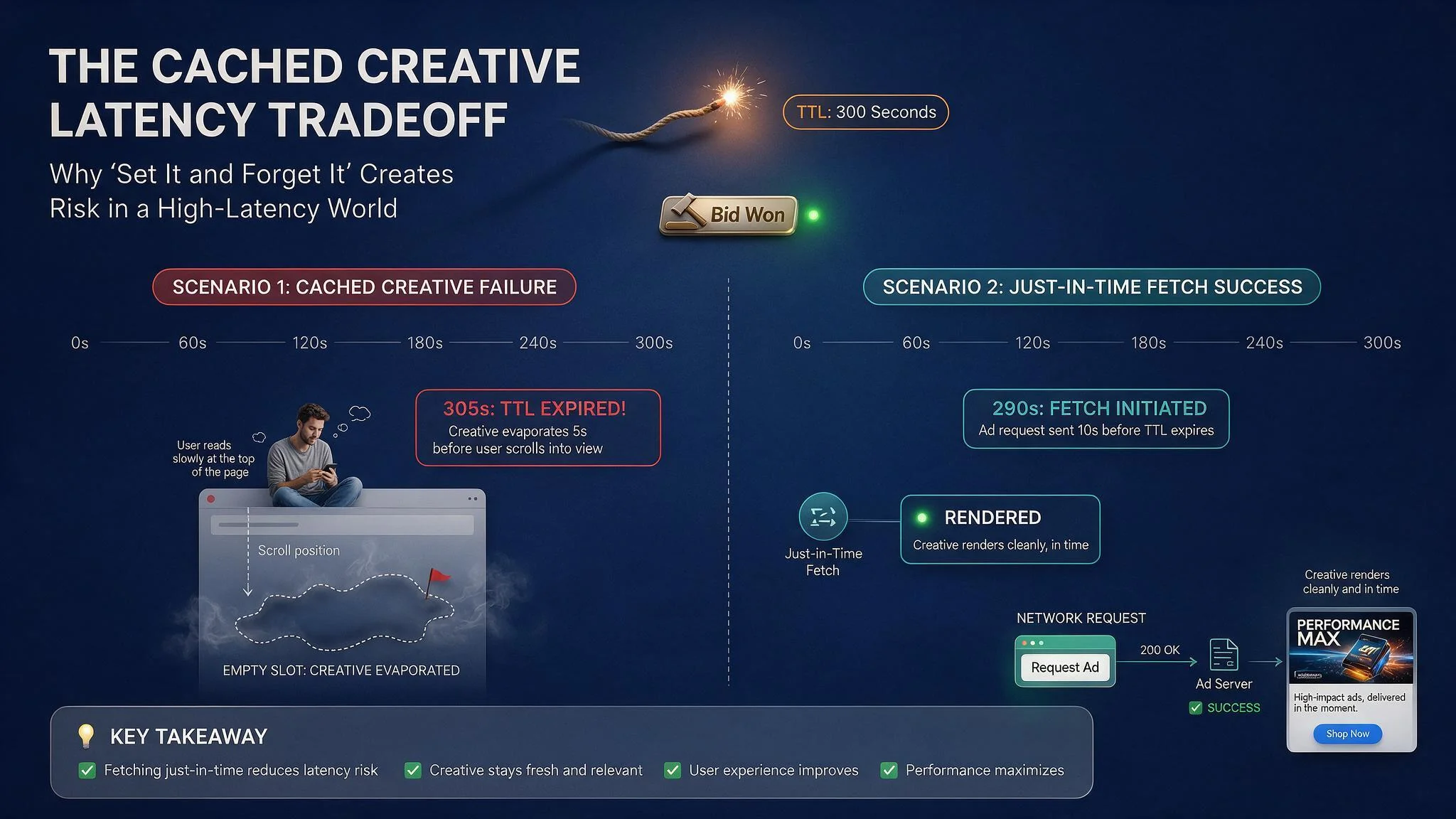
Blank ads frequently appear on content-heavy pages when AdOps teams configure GPT lazy loading (googletag.pubads().enableLazyLoad()) or custom scroll-triggered rendering without synchronizing Prebid's auction timing. If pbjs.requestBids() runs for all ten page slots at initial page load (t = 0s), GAM immediately receives the targeting key-values (hb_adid, hb_pb) for footer placements (ad-slot-footer). However, if GAM holds back the actual rendering of ad-slot-footer until the user scrolls near the bottom of the article at t = 320s, the cached Prebid bid has already exceeded its 300-second TTL.
When the user finally scrolls into range, GAM injects the winning Prebid Universal Creative into the slot and invokes pbjs.renderAd(document, adId). Because Prebid's internal expiry timer has already purged or marked that adId as expired, renderAd fails to populate the iframe, firing adRenderFailed with the reason CANNOT_FIND_AD or EXPIRED and leaving a blank box on the page.
To eliminate TTL expiration blanks, publishers must never run header bidding auctions for below-the-fold slots on initial page load unless those slots will render immediately. Instead, trigger pbjs.requestBids() just-in-time via an IntersectionObserver matched to your lazy-load fetch margin, and monitor Prebid's staleRender and adRenderFailed events to trigger an immediate slot refresh when an expired bid slips through:
window.pbjs = window.pbjs || { que: [] };

pbjs.que.push(function () {
  // Adjust ttlBuffer to give a safe margin before GAM attempts to render
  pbjs.setConfig({
    ttlBuffer: 10,
    auctionOptions: {
      suppressStaleRender: true // Prevent rendering expired cached bids
    }
  });

  // Catch TTL expiration or missing adId failures and recover the slot
  pbjs.onEvent('adRenderFailed', function (data) {
    console.warn('[AdOps Telemetry] Prebid render failed:', data.reason, data.adId);

    if (data.reason === 'preventWritingOnMainDocument' || data.reason === 'CANNOT_FIND_AD' || data.reason === 'EXPIRED') {
      const targetSlot = googletag.pubads().getSlots().find(function (slot) {
        return slot.getTargeting('hb_adid')[0] === data.adId;
      });

      if (targetSlot) {
        targetSlot.clearTargeting();
        pbjs.requestBids({
          adUnitCodes: [targetSlot.getSlotElementId()],
          bidsBackHandler: function () {
            pbjs.setTargetingForGPTAsync([targetSlot.getSlotElementId()]);
            googletag.pubads().refresh([targetSlot], { changeCorrelator: false });
          }
        });
      }
    }
  });
});
Detecting Blank Slots Automatically via DOM MutationObserver
Because standard ad server delivery reports count an impression the moment the creative wrapper leaves GAM, publishers cannot rely on ad server UI metrics to quantify blank ad rates. Capturing true rendering failures requires client-side DOM telemetry that feeds directly into real-time diagnostic reporting pipelines.
By combining GPT's slotRenderEnded event with a MutationObserver and iframe inspection routine, engineering teams can verify whether an ad slot that claimed to fill (event.isEmpty === false) actually produced visible DOM elements within a strict grace window (for example, 2500 milliseconds after wrapper injection). For friendly iframes (such as Prebid Universal Creative renders), the script inspects the child document directly to confirm that non-empty visual elements (<img>, <canvas>, <video>, or nested <iframe> nodes with positive bounding dimensions) exist. For cross-origin SafeFrames where the Same-Origin Policy blocks contentDocument inspection, the script verifies that the outer iframe maintains non-zero layout dimensions (offsetWidth > 0 && offsetHeight > 0) and cross-references securitypolicyviolation events on the page.
window.googletag = window.googletag || { cmd: [] };

googletag.cmd.push(function () {
  googletag.pubads().addEventListener('slotRenderEnded', function (event) {
    if (event.isEmpty) return; // Legitimate unfilled auction, handled by collapseEmptyDivs

    const slotId = event.slot.getSlotElementId();
    const container = document.getElementById(slotId);
    if (!container) return;

    const verifySlotRender = function () {
      const iframe = container.querySelector('iframe');
      if (!iframe || iframe.offsetWidth === 0 || iframe.offsetHeight === 0) {
        reportBlankSlot(slotId, event, 'ZERO_DIMENSION_OR_MISSING_IFRAME');
        return;
      }

      try {
        // Friendly iframe inspection (e.g., Prebid Universal Creative)
        const doc = iframe.contentDocument || iframe.contentWindow.document;
        if (doc && doc.body) {
          const hasVisualNodes = doc.body.querySelector('img, canvas, video, iframe, svg, a');
          const bodyRect = doc.body.getBoundingClientRect();
          if (!hasVisualNodes && bodyRect.height < 2) {
            reportBlankSlot(slotId, event, 'EMPTY_FRIENDLY_IFRAME_DOM');
          }
        }
      } catch (crossOriginError) {
        // Cross-origin SafeFrame: attach a dimension observer to catch collapsed frames
        const observer = new MutationObserver(function () {
          if (iframe.offsetHeight === 0 || iframe.style.display === 'none') {
            reportBlankSlot(slotId, event, 'SAFEFRAME_COLLAPSED_POST_RENDER');
            observer.disconnect();
          }
        });
        observer.observe(iframe, { attributes: true, attributeFilter: ['style', 'width', 'height'] });
      }
    };

    // Inspect after a 2500ms grace period to allow async creative bundles to paint
    setTimeout(verifySlotRender, 2500);
  });
});

function reportBlankSlot(slotId, gptEvent, failureCode) {
  const payload = {
    slotId: slotId,
    lineItemId: gptEvent.lineItemId,
    creativeId: gptEvent.creativeId,
    advertiserId: gptEvent.advertiserId,
    failureCode: failureCode,
    timestamp: Date.now()
  };
  navigator.sendBeacon('/api/v1/adops-telemetry/blank-slot', JSON.stringify(payload));
}
Resolving blank ad slots at scale requires treating creative rendering as an observable distributed systems problem rather than an isolated trafficking error. By enforcing imp.secure = 1 at the OpenRTB bid request layer, deploying Content-Security-Policy: upgrade-insecure-requests alongside a ReportingObserver to catch broken TLS handshakes, coupling Prebid auction triggers strictly to viewport proximity, and running automated MutationObserver telemetry on every slotRenderEnded event, engineering teams can identify offending line items (event.lineItemId) and demand seats within minutes. Closing the gap between auction wins and painted pixels immediately recovers lost CPM yield, protects historical slot viewability scores, and preserves user experience across every pageview.