
Monetizing International and Multi-Geo Traffic: Tier-1 vs. Tier-2/3 Demand Routing and Floor Localization
When an OpenRTB 2.6 bid request carries an imp[].bidfloor value calibrated for United States domestic traffic into a global auction, buy-side bid evaluators

When an OpenRTB 2.6 bid request carries an imp[].bidfloor value calibrated for United States domestic traffic into a global auction, buy-side bid evaluators drop 80% to 95% of international impressions before executing valuation models. Publishers operating mobile apps, Connected TV (CTV) channels, and high-volume web properties frequently expand their international user base only to discover that non-US traffic yields a fraction of its addressable revenue potential. The root cause is rarely an absence of international advertiser demand. Instead, the failure stems from applying a uniform, US-centric auction architecture across heterogeneous global markets that operate on fundamentally different clearing price distributions, network latency profiles, currency settlement rails, and regional demand paths.
In programmatic auctions, traffic is segmented by media buyers into distinct geographic tiers based on macroeconomic purchasing power, digital ad spend density, and identity signal availability. Tier-1 markets (such as the United States, United Kingdom, Canada, Germany, Australia, and Japan) exhibit high bidder concurrency and deep brand budgets, whereas Tier-2 and Tier-3 regions across Latin America (LATAM), the Middle East and North Africa (MENA), and Southeast Asia (SEA) rely heavily on regional performance buyers, telecom-backed DSPs, and local agency trading desks. Treating these disparate markets as a single monolithic inventory pool distorts supply path optimization (SPO) metrics and starves international impressions of competitive bid density.
At Sky Boosts, our engineering teams architect geo-aware monetization pipelines across Google Ad Manager (GAM 360), AdX, Open Bidding, and Prebid (spanning Prebid.js 11.x, Prebid Server Go/Java, and Prebid Mobile SDK). By combining 100% Google-friendly, HUMAN and Pixalate IVT-clean inventory standards with localized demand routing and reliable Net-30 and Net-60 publisher payouts, we isolate regional yield dynamics so every geographic cohort clears at its true market ceiling.
Why US-Centric Floor Prices Zero Out Fill in LATAM, MENA, and SEA
Price floors serve two primary economic functions in a first-price programmatic auction: they establish a minimum reserve price for publisher inventory, and they counteract aggressive buy-side bid shading algorithms. In Tier-1 markets, where 10 to 15 demand partners actively compete on a single impression, DSP bid shading models examine historical clearing price distributions to discount a buyer's gross valuation down toward the expected second-highest bid. Under high bid density, a well-calibrated hard floor in GAM Unified Pricing Rules (UPRs) or Prebid forces the shading algorithm to clear closer to the advertiser's true maximum willingness to pay.
That mathematical model collapses when applied indiscriminately to LATAM, MENA, and SEA traffic. Consider a standard 300x250 mobile web banner or an instream video placement. In the United States, median clearing prices for verified, brand-safe inventory might cluster between $1.80 and $3.50 USD eCPM for display, and $12.00 to $18.00 USD eCPM for CTV video. If an AdOps team sets a static global floor of $1.20 USD for display and $8.00 USD for video, they capture healthy yield in New York and London while completely pricing out legitimate buyers in Sao Paulo, Cairo, Jakarta, and Ho Chi Minh City.
In emerging markets, clearing prices follow a heavily skewed bimodal distribution. A tiny fraction of impressions (typically 3% to 5%) attracts cross-border multinational brand campaigns or high-intent retargeting bids that can clear above US-level floors. The remaining 95% of addressable demand consists of domestic e-commerce, regional fintech, mobile gaming user acquisition, and local consumer packaged goods (CPG) campaigns. As documented in our quarterly eCPM benchmarks, natural clearing prices in Tier-2 and Tier-3 markets routinely cluster between $0.15 and $0.65 USD for display and $1.50 to $4.50 USD for video, reflecting local currency purchasing power parity and lower domestic customer acquisition costs.
When a publisher enforces a $1.20 USD floor on traffic from Brazil (BRA), Indonesia (IDN), or Egypt (EGY), three cascading failure modes occur simultaneously:
- Pre-Auction Bid Filtering: Participating SSP partners and tier-1 DSPs inspect
imp[].bidfloorat the ingestion edge. Because the requested floor exceeds the 99th percentile of historical clearing prices for that country code, the DSP halts bid evaluation immediately to conserve compute cycles, returning an HTTP 204 No Content response. - GAM Backfill Starvation and Passback Loops: With zero valid header bidding responses reaching the ad server, the impression falls through to Google Ad Manager. If the publisher has replicated the same unlocalized floor inside GAM Unified Pricing Rules, AdX and Open Bidding buyers are similarly blocked. The impression either goes unfilled or triggers high-latency client-side passback chains that degrade Core Web Vitals and viewability.
- Supply Path QPS Throttling: Buy-side platforms continuously score supply paths based on bid-to-request ratios and win rates. When a publisher floods DSP endpoints with millions of international bid requests carrying unachievable floor prices, the DSP's traffic shaping algorithms classify the inventory source as low-yield noise and throttle incoming queries per second (QPS), which subsequently degrades auction performance even on the publisher's domestic Tier-1 traffic.
Building a Geo-Segmented Bidder Topology in Prebid Server
Resolving international monetization gaps requires decoupling demand orchestration from the client device. In emerging markets across LATAM, MENA, and SEA, a substantial portion of mobile web and in-app traffic operates over congested cellular networks with high round-trip times (RTT) and runs on mid-tier or entry-level Android hardware. Executing a heavy client-side Prebid.js 11.x wrapper that initiates 12 concurrent TLS handshakes from a browser in Manila or Bogota to US-East data centers guarantees that most bid responses will arrive after the auction timeout curve expires.
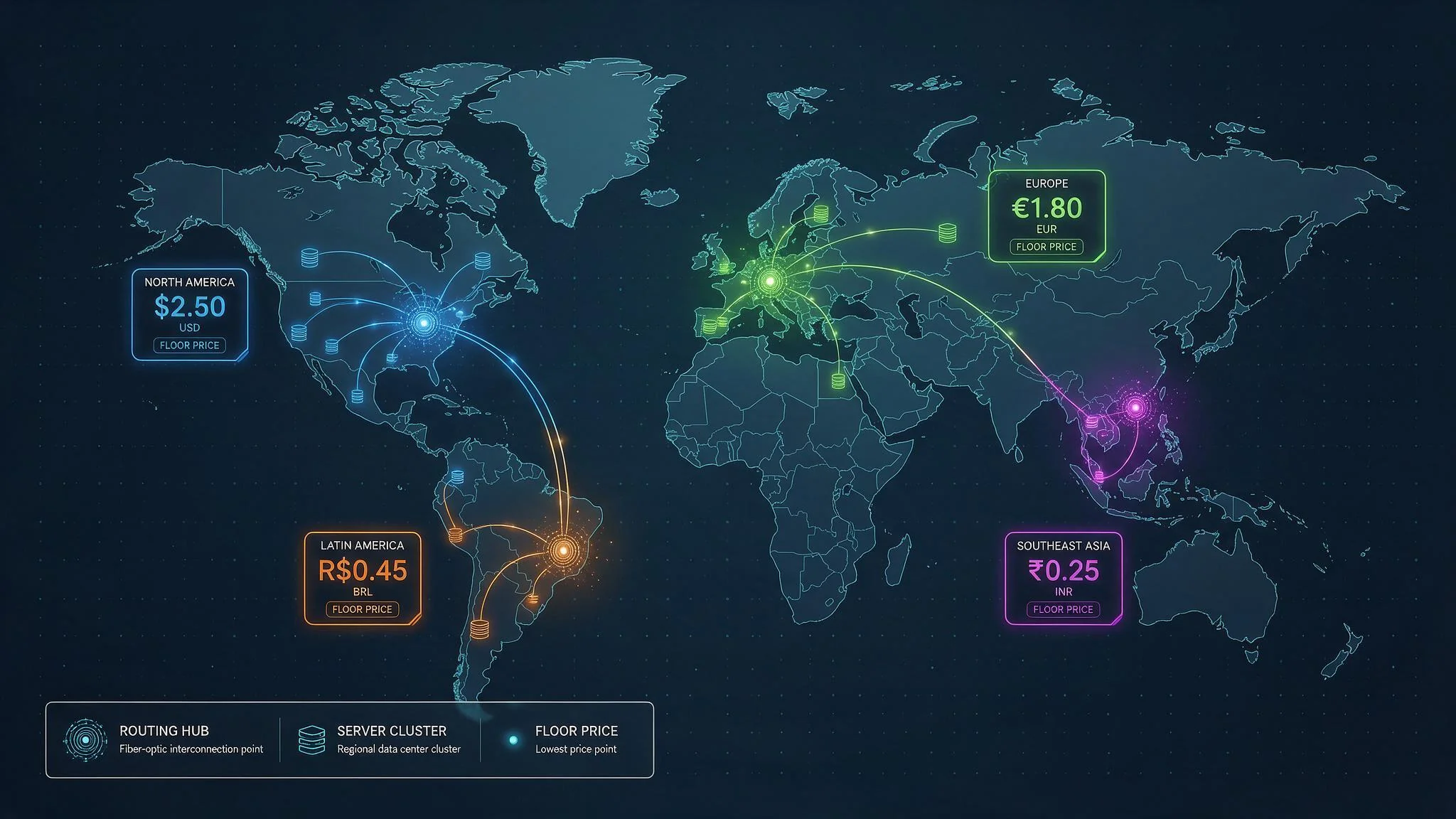
Migrating international demand execution to a geo-distributed Prebid Server cluster eliminates client-side connection bottlenecks. Instead of firing a dozen parallel requests from the user's device, the client SDK or lightweight Prebid.js wrapper transmits a single compressed OpenRTB 2.6 payload to the nearest regional edge Point of Presence (PoP), such as AWS sa-east-1 (Sao Paulo), me-central-1 (UAE), ap-southeast-1 (Singapore), or eu-central-1 (Frankfurt). From that regional hub, our global demand infrastructure executes server-to-server fan-out over persistent HTTP/2 and HTTP/3 connections directly to co-located DSP endpoints.
Server-side deployment also enables strict geo-segmented bidder routing. A common architectural anti-pattern in publisher-managed Prebid setups is broadcasting every impression to every configured adapter. Calling a North American retail media SSP on an impression originating in Vietnam wastes server CPU, consumes outbound bandwidth, and harms the publisher's SPO standing. By implementing a geo-segmented bidder matrix inside Prebid Server stored requests, AdOps engineers restrict North American and Western European specialists to Tier-1 geos while selectively activating regional SSPs and local DSP connections only when the request originates within their target footprint.
Routing Regional Demand Specialists Using ISO-3166 Country Codes
Accurate geo-segmentation depends on strict data hygiene at the edge ingestion layer. A pervasive engineering bug in multi-geo programmatic stacks arises from mismatched country code standards across CDN headers, Consent Management Platforms (CMPs), and OpenRTB payloads. The official ISO 3166-1 country code standard defines both two-letter (Alpha-2) and three-letter (Alpha-3) geographic identifiers. Most edge CDNs (such as Cloudflare's CF-IPCountry or AWS CloudFront's CloudFront-Viewer-Country), MaxMind GeoIP2 lookups, and IAB TCF v2.2 / GPP consent strings output Alpha-2 codes (US, GB, DE, BR, IN, JP). Conversely, the OpenRTB 2.6 specification explicitly mandates ISO 3166-1 Alpha-3 codes (USA, GBR, DEU, BRA, IND, JPN) inside the device.geo.country attribute.
When a publisher or ad network injects an unnormalized Alpha-2 string directly into device.geo.country, downstream demand parsers fail schema validation. Some DSPs silently drop the geo object and treat the impression as geo-unknown traffic, while others reject the bid request outright with a malformed payload error. To connect effectively with our curated international demand partners, Prebid Server must execute deterministic Alpha-2 to Alpha-3 normalization before evaluating stored request routing rules or price floor lookups.
Below is a production-grade Prebid Server Go middleware configuration pattern demonstrating edge geo-normalization and regional bidder matrix routing across Tier-1, LATAM, and SEA traffic cohorts:
# Prebid Server (Go) Geo-Normalization & Regional Bidder Routing Configuration
host-cookie:
  opt-out-cookie:
    name: "trp_optout"
    value: "true"

geo_lookup:
  enabled: true
  provider: "maxmind"
  db_path: "/opt/geoip/GeoLite2-City.mmdb"
  # Normalize CDN Alpha-2 headers to OpenRTB 2.6 ISO 3166-1 Alpha-3
  header_fallback: "CloudFront-Viewer-Country"
  enforce_alpha3: true

bidder_routing:
  default_timeout_ms: 280
  regional_clusters:
    TIER1_CORE:
      countries: ["USA", "CAN", "GBR", "DEU", "FRA", "AUS", "JPN"]
      active_bidders: ["google_ob", "amazon_tam", "tier1_global_dsp_a", "tier1_global_dsp_b"]
      max_qps_per_pod: 5000
    LATAM_REGIONAL:
      countries: ["BRA", "MEX", "ARG", "COL", "CHL", "PER"]
      active_bidders: ["google_ob", "latam_specialist_ssp", "brazil_local_dsp", "tier1_global_dsp_a"]
      timeout_override_ms: 350
    SEA_MENA_GROWTH:
      countries: ["IDN", "VNM", "THA", "PHL", "MYS", "SGP", "SAU", "ARE", "EGY"]
      active_bidders: ["google_ob", "apac_mobile_ssp", "mena_video_exchange", "sea_telco_dsp"]
      timeout_override_ms: 380
Notice the timeout_override_ms parameter assigned to the LATAM_REGIONAL and SEA_MENA_GROWTH clusters. While a 250ms to 280ms server-side auction timeout is optimal for low-latency fiber interconnects in Virginia (us-east-1) or Frankfurt (eu-central-1), regional DSPs in emerging markets frequently require an additional 70ms to 100ms to complete cross-border database lookups and currency translation. Relaxing the server-side timeout slightly for Tier-2 and Tier-3 cohorts captures late-arriving regional bids without blocking client-side page rendering.
Dynamic Floor Localization Using Prebid Server Floors (country Dimension) and Currency Conversion
Once regional demand partners are properly routed, the auction must enforce localized reserve prices that reflect real-time regional clearing distributions. Implementing granular geo-floors in client-side Prebid.js is operationally cumbersome. Client-side scripts lack native geo-IP awareness unless the publisher builds custom asynchronous middleware to query a geo endpoint before initializing pbjs.setConfig({ floors: ... }), and shipping a massive JSON floor matrix covering 190 countries to every user's browser bloats payload weight and degrades Time to Interactive (TTI).
Moving floor enforcement to the server resolves both constraints. Unlike client-side Prebid.js, Prebid Server Price Floors natively supports country and deviceType as built-in floor schema dimensions alongside mediaType, gptSlot, and size. Because Prebid Server resolves the user's ISO 3166-1 Alpha-3 country code and User-Agent device classification at the network edge, the floors module can evaluate multi-dimensional rules in sub-millisecond memory lookups without exposing the publisher's global pricing strategy in client-side network traffic.
The following JSON configuration illustrates a production Prebid Server Price Floors payload returned by a dynamic floor provider endpoint, utilizing the native country and deviceType dimensions alongside currency conversion guardrails:
{
  "currency": "USD",
  "skipRate": 5,
  "modelGroups": [
    {
      "modelVersion": "skyboosts-geo-elasticity-v4.2",
      "modelWeight": 100,
      "schema": {
        "delimiter": "|",
        "fields": ["country", "deviceType", "mediaType", "size"]
      },
      "values": {
        "USA|ctv|video|1920x1080": 11.50,
        "USA|phone|banner|300x250": 1.35,
        "GBR|phone|banner|300x250": 1.10,
        "BRA|ctv|video|1920x1080": 3.20,
        "BRA|phone|banner|300x250": 0.32,
        "MEX|phone|banner|300x250": 0.38,
        "ARE|phone|banner|300x250": 0.75,
        "SAU|phone|banner|300x250": 0.68,
        "IDN|phone|banner|300x250": 0.18,
        "VNM|phone|banner|300x250": 0.16,
        "*|ctv|video|*": 2.40,
        "*|phone|banner|300x250": 0.22,
        "*|*|*|*": 0.12
      },
      "default": 0.12
    }
  ]
}
When deploying localized floors across international markets, currency conversion mechanics require strict synchronization between Prebid Server and Google Ad Manager. Many regional buyers in Brazil, Japan, the United Kingdom, and the European Union transact natively in local currencies (BRL, JPY, GBP, EUR). If a regional DSP ingests an OpenRTB request where imp[].bidfloorcur is set to USD, but the buyer's internal campaign budget is denominated in Brazilian Real (BRL), the buyer's bidder adapter must either rely on Prebid Server's currency conversion service or execute its own foreign exchange (FX) translation.
In production, Sky Boosts configures Prebid Server's currency conversion module to poll institutional FX rate tables every 60 minutes. When a rule in the values map matches BRA|phone|banner|300x250 at 0.32 USD, and a local Brazilian demand partner requires bid requests denominated in BRL, Prebid Server automatically translates imp[].bidfloor using the active FX rate, sets imp[].bidfloorcur: "BRL", and converts the partner's returned BRL bid back into the publisher's base ad server currency before passing hb_pb targeting keys to GAM 360. Furthermore, retaining a skipRate: 5 (5% no-floor control group) per geographic cohort allows our yield algorithms to continuously sample true unfloored clearing price distributions in every country, adjusting floor elasticity automatically when seasonal buying spikes occur (such as Ramadan in MENA, Singles' Day in SEA, or El Buen Fin in Mexico).
Handling Multi-Language Content Classification in OpenRTB content.language
Geographic IP location alone is an incomplete proxy for audience valuation. Modern media consumption involves massive cross-border and diaspora audiences: tens of millions of users in the United States consume Spanish-language CTV and web content; expatriate professionals in the United Arab Emirates (ARE), Singapore (SGP), and India (IND) read English-language financial and technology publications; and French-speaking audiences span Europe, North Africa, and Canada.
When a publisher relies solely on device.geo.country without passing explicit language and contextual taxonomy signals, two revenue leaks occur. First, Tier-1 multicultural media buyers (such as US Hispanic agency trading desks or global English B2B tech advertisers) cannot programmatically identify qualifying inventory if the language signal is absent from the OpenRTB payload. Second, automated brand-safety verification scanners (including HUMAN, Pixalate, and DSP pre-bid contextual filters) frequently misclassify foreign-language pages when language metadata is omitted, triggering false-positive brand safety blocks when benign words in Spanish, Portuguese, or Indonesian collide with English-language negative keyword lists.
To maximize demand eligibility and protect brand safety across multi-geo inventory, publishers must explicitly populate the OpenRTB 2.6 site.content.language (or app.content.language) attribute using two-letter ISO 639-1 codes, supplemented by content.ext.languagebcp47 when regional dialect specificity (such as es-MX vs. es-ES or pt-BR vs. pt-PT) impacts buyer targeting. Below is a Prebid.js 11.x implementation that injects validated first-party language and IAB Content Taxonomy 3.0 (cattax: 7) signals directly into the global OpenRTB 2.6 configuration object:
// Prebid.js 11.x Multi-Language & Contextual Taxonomy Injection
window.pbjs = window.pbjs || { que: [] };

pbjs.que.push(function () {
  const docLang = document.documentElement.lang || 'en-US';
  const iso639_1 = docLang.split('-')[0].toLowerCase();

  pbjs.setConfig({
    ortb2: {
      site: {
        content: {
          language: iso639_1,
          cattax: 7, // IAB Content Taxonomy 3.0
          cat: ['52', '56'], // Business and Finance > Economy, Markets
          ext: {
            languagebcp47: docLang
          }
        }
      }
    }
  });
});
Passing accurate site.content.language and languagebcp47 fields alongside normalized ISO 3166-1 Alpha-3 country codes allows high-value international demand to bid with confidence. An English-language financial article read by an executive in Jakarta or Dubai can bypass low local display floors and attract Tier-1 global B2B demand, while a Spanish-language CTV stream viewed in Los Angeles or Miami routes directly into premium US Hispanic video budgets.
For engineering and AdOps teams auditing their international monetization stack, the remediation roadmap is concrete: first, verify at the Prebid Server ingress layer that all CDN and CMP Alpha-2 country codes are normalized to ISO 3166-1 Alpha-3 before populating device.geo.country. Second, dismantle static US-centric GAM Unified Pricing Rules and migrate floor logic to Prebid Server Price Floors using the native country|deviceType|mediaType|size dimensional schema with a 5% skipRate control group. Finally, partition Prebid Server bidder routing into regional geographic clusters and enforce strict content.language tagging across all web, mobile app, and CTV endpoints. Aligning floor localization and demand topology with regional auction mechanics transforms unmonetized international traffic into predictable, high-fill programmatic yield.