
Viewability Engineering on the Modern Web: IntersectionObserver API, Prebid 11.0 Viewability Modules, and CLS Prevention
Tier-1 demand-side platform (DSP) bid-shading algorithms penalize supply paths when historical slot viewability drops below 70%, discounting clearing prices

Tier-1 demand-side platform (DSP) bid-shading algorithms penalize supply paths when historical slot viewability drops below 70%, discounting clearing prices by 35% to 60% before an auction even closes. On the sell side, viewability is no longer a passive post-impression reporting metric; it is a primary pricing signal embedded directly into OpenRTB 2.6 bid requests and DSP pacing models. When an ad unit fires a bid request three viewports below the fold and renders immediately upon auction completion, the creative sits unviewed in the DOM while the user reads upper-page content. If the user exits before scrolling, that rendered impression registers as a non-viewable event in Google Ad Manager (GAM) Active View and buy-side verification scripts, dragging down the placement's historical viewability score and suppressing future eCPMs across all participating bidders.
Historically, publishers attempted to solve this problem by attaching synchronous JavaScript listeners to the window.onscroll event and invoking Element.getBoundingClientRect() on every scroll tick to measure ad slot proximity. On complex Document Object Models (DOMs), querying layout geometry synchronously on the browser main thread triggers forced synchronous reflows (layout thrashing), causing frame drops during user scrolling and starving Prebid.js auction execution of CPU cycles. Furthermore, delaying ad rendering without pre-allocating exact structural geometry introduces severe Cumulative Layout Shift (CLS) penalties when multi-size or fluid creatives inject asynchronously into the document flow.
Modern viewability engineering resolves the tension between auction lead time, main-thread responsiveness, and layout stability through three architectural pillars: off-main-thread geometry tracking via the W3C IntersectionObserver API, standardized DOM element binding and event tracking in Prebid.js 11.0, and deterministic CSS container reservation that eliminates reflow across multi-size and native inventory.
MRC Viewability Thresholds (50% Pixels for 1s Display / 2s Video)
The Media Rating Council (MRC) and the IAB Tech Lab define the baseline industry specifications for what constitutes a countable, viewable impression across web environments. For standard display creatives, at least 50% of the creative's total pixel area must reside within the active, visible portion of the browser viewport for a minimum of one continuous second (1,000 milliseconds) after the creative assets have completed rendering. Recognizing that high-impact canvas units occupy a massive footprint on smaller laptop and mobile screens, the MRC specification establishes a distinct threshold for large display formats measuring 242,500 pixels or greater (equivalent to a 970x250 billboard, a 300x1050 portrait unit, or a 300x600 half-page unit with surrounding frame margins): these large formats require 30% of their pixels to remain in the active viewport for one continuous second. For instream and outstream video inventory, 50% of the video player's pixels must remain visible in the active viewport for two continuous seconds (2,000 milliseconds) while video playback is actively progressing.
Underneath these top-line numbers lies strict timer state-machine logic enforced by Google Publisher Tag (GPT) Active View and Open Measurement (OMID) verification scripts. The continuous duration timer does not accumulate fractional time across multiple scroll passes. If 55% of a 300x250 placement enters the viewport for 850 milliseconds and the user scrolls rapidly downward so that only 45% remains visible, the continuous clock resets to zero. The slot must re-establish at least 50% pixel intersection for an uninterrupted 1,000-millisecond window to trigger the impressionViewable state. Additionally, the browser window itself must pass focus and visibility checks: if document.visibilityState evaluates to 'hidden' because the user switched browser tabs or minimized the window, pixel intersection polling pauses immediately regardless of the slot's coordinates inside the layout tree.
From a yield architecture standpoint, meeting these exact thresholds governs how buy-side algorithms value inventory. Tier-1 DSPs ingest historical placement-level viewability telemetry and apply real-time vCPM (viewable cost per mille) normalization to every outbound bid. Consider a DSP targeting a $4.00 vCPM goal for a mainstream consumer brand campaign. If an ad unit carries an 80% historical viewability rate, the DSP can bid $3.20 gross eCPM and achieve its target cost per viewable impression. If poorly tuned lazy loading or slow creative rendering drops that same placement to 42% viewability, the DSP either throttles QPS to the placement entirely via pre-bid filtering or shades its bid down to $1.68 eCPM. On Google AdX and Open Bidding, crossing the 70% and 80% viewability tiers unlocks restricted brand-safe budgets that enforce strict pre-bid viewability floors. Maintaining rigorous viewability measurement and verification alongside HUMAN and Pixalate invalid traffic (IVT) filtration ensures that every impression clears at maximum buyer confidence without post-auction clawbacks.
Implementing Margin-Based Lazy Loading with IntersectionObserver
To maximize viewability without starving header bidding partners of auction response time, engineering teams must decouple the auction request trigger from the creative render trigger. Firing a Prebid.js and GAM auction only when an ad container reaches 0px from the viewport edge guarantees a high viewability-to-render ratio, but it introduces a fatal latency bottleneck: if the header bidding wrapper takes 800ms to 1,000ms to resolve bids, followed by 250ms for GAM line item selection and creative document construction, a user scrolling at a moderate velocity of 700 pixels per second will scroll past the slot before the creative ever paints. This phenomenon, known in AdOps telemetry as "scroll-past loss," destroys fill rate and viewable completion simultaneously.
The solution is a two-stage margin-based pipeline powered by the browser's native IntersectionObserver API, which asynchronously tracks element visibility against a root viewport using rootMargin, scrollMargin, threshold arrays, and optional trackVisibility (with a minimum 100ms delay) to detect visual occlusion or opacity compromises off the main thread. Unlike legacy scroll listeners that poll layout dimensions on every frame, IntersectionObserver registers target DOM elements with the browser's internal C++ layout and compositing engine. The browser evaluates intersection geometry during its native rendering lifecycle and queues a callback on the main thread only when a configured threshold or margin boundary is crossed.
In a two-stage programmatic architecture, the first observer (the Fetch Observer) uses an expanded outer boundary to initiate the Prebid.js auction and GAM ad request while the slot is still 1.2 to 2.0 viewports away from the visible screen. Once the auction resolves, the winning bid payload is cached in memory or held inside an unrendered slot state. The second observer (the Render & Viewability Observer) monitors a tighter boundary near the actual viewport edge to trigger creative rendering and track the exact 50% pixel threshold required by the MRC standard.
Configuring rootMargin, scrollMargin, and trackVisibility Options
Calibrating the IntersectionObserver configuration object requires mapping CSS pixel margins to real-world network latency and device scroll physics. The rootMargin property accepts a string formatted identically to CSS margin shorthand ("top right bottom left" in px or %), expanding or contracting the bounding box of the root viewport prior to calculating intersections. For mobile web traffic where vertical flick scrolling accelerates viewport velocity, setting a bottom rootMargin of "150% 0px" or "1200px 0px" provides the exact lead time needed for a 1,000ms Prebid auction timeout curve to resolve before the slot enters the user's field of vision. On desktop viewports where scroll velocity is lower and viewport height is larger, a tighter "600px 0px" or "80% 0px" margin prevents speculative bid requests on long-form articles where users may bounce mid-page, protecting bid-to-impression ratios (render rates) for participating SSP partners.
For complex web applications that house ad units inside nested scrollable containers, such as infinite-scroll news feeds, dual-pane webmail layouts, or horizontal media carousels, rootMargin alone is insufficient because it only expands the outermost root element (typically the document viewport). Modern Chromium implementations support the scrollMargin property on the IntersectionObserver constructor. While rootMargin adjusts the outer root bounds, scrollMargin expands the clipping rectangle of all intermediate scrollable ancestors nested between the root and the target ad unit. When an ad slot sits inside an overflow-y: auto container, configuring scrollMargin: "400px 0px" ensures the observer fires as the user scrolls within that nested pane, preventing late auction triggers inside componentized React or Next.js layouts.
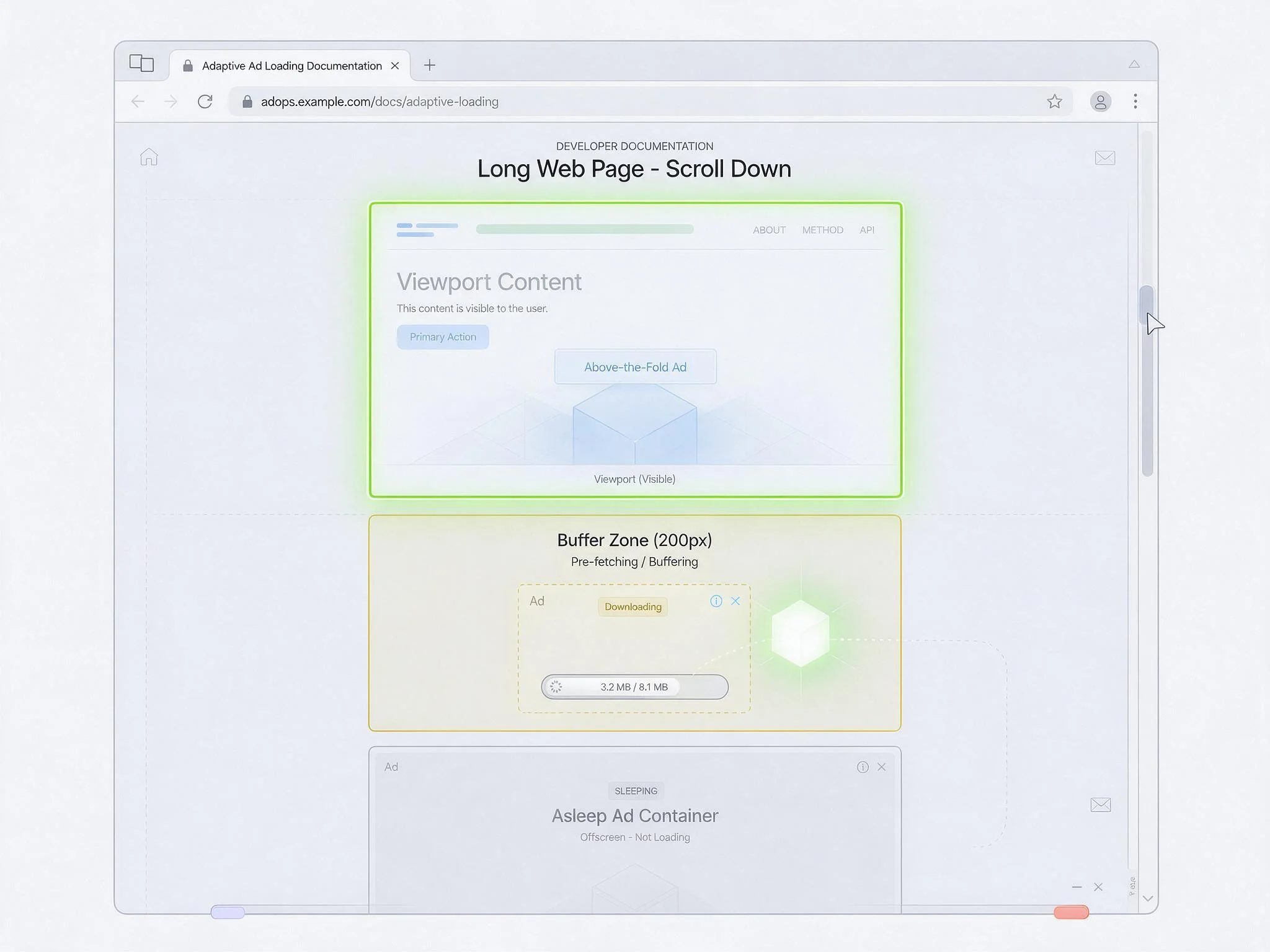
To move from basic geometric intersection to true visual verification, IntersectionObserver v2 introduced the trackVisibility boolean and delay integer options. Under v1 geometry rules, an observer reports isIntersecting: true with an intersectionRatio of 1.0 even if the ad slot is covered by a fixed-position cookie consent banner, obscured by a floating video player, or styled with opacity: 0 during a CSS transition. Enabling trackVisibility: true instructs the browser's compositor to verify that the target element is genuinely visible to the user, checking for zero opacity, CSS 3D transforms, filters, and overlapping z-index occlusions. Because computing pixel-level occlusion across the compositing tree is computationally heavier than bounding-box math, the specification requires setting at least delay: 100 (100 milliseconds) whenever trackVisibility is enabled, batching visibility evaluations and exposing the true state via entry.isVisible.
const AUCTION_TIMEOUT_MS = 1000;

// Stage 1: Fetch Observer triggers Prebid + GPT auction ahead of viewport entry
const fetchObserver = new IntersectionObserver((entries, observer) => {
  entries.forEach((entry) => {
    if (!entry.isIntersecting) return;
    const slotElement = entry.target;
    const adUnitCode = slotElement.dataset.adUnitCode;

    observer.unobserve(slotElement);
    triggerProgrammaticAuction(adUnitCode, slotElement);
  });
}, {
  root: null,
  rootMargin: '1000px 0px 1000px 0px',
  scrollMargin: '400px 0px 400px 0px',
  threshold: 0.0
});

// Stage 2: MRC Viewability Observer verifies unoccluded 50% pixel threshold for 1s
const activeTimers = new WeakMap();

const mrcViewabilityObserver = new IntersectionObserver((entries) => {
  entries.forEach((entry) => {
    const el = entry.target;
    const meetsGeometry = entry.isIntersecting && entry.intersectionRatio >= 0.5;
    const meetsVisibility = ('isVisible' in entry) ? entry.isVisible : true;

    if (meetsGeometry && meetsVisibility && document.visibilityState === 'visible') {
      if (!activeTimers.has(el)) {
        const timerId = window.setTimeout(() => {
          activeTimers.delete(el);
          mrcViewabilityObserver.unobserve(el);
          el.dispatchEvent(new CustomEvent('skyboosts:mrcViewable', {
            detail: { ratio: entry.intersectionRatio, timestamp: performance.now() }
          }));
        }, 1000);
        activeTimers.set(el, timerId);
      }
    } else if (activeTimers.has(el)) {
      window.clearTimeout(activeTimers.get(el));
      activeTimers.delete(el);
    }
  });
}, {
  root: null,
  rootMargin: '0px',
  threshold: [0.0, 0.3, 0.5, 1.0],
  trackVisibility: true,
  delay: 100
});
By pairing the threshold: [0.0, 0.3, 0.5, 1.0] array with a WeakMap timer registry, the Stage 2 observer accurately handles both standard display units (0.5 threshold) and large formats (0.3 threshold) while automatically garbage-collecting references if single-page application (SPA) route changes remove the ad container from the DOM.
Prebid.js 11.0 Viewability Overhaul: adUnit.element, bidViewability, and bidViewabilityIO
Prior to the 11.0 major release, DOM node resolution inside Prebid.js was fragmented across dozens of individual bidder adapters and analytics modules. When an adapter needed to inspect the physical dimensions, viewport position, or CSS visibility of an ad slot to populate imp.banner.pos or calculate predicted viewability in an OpenRTB bid request, it typically executed document.getElementById(adUnit.code) or queried the Google Publisher Tag API (googletag.pubads().getSlots()) to match the slot's element ID. In modern component frameworks using Shadow DOM, dynamically generated CSS-in-JS IDs, or non-GAM ad server architectures, adUnit.code frequently represents an abstract logical placement path (such as "/1234567/homepage/in_article_1") rather than an HTML id attribute, causing adapter DOM lookups to fail silently and send pos: 0 (unknown position) in outbound bid requests.
As documented in the official Prebid.js 11.0 release notes, Prebid 11.0 standardized viewability and DOM association via the first-class adUnit.element property (and the internal getAdUnitElement utility) alongside two unified viewability modules: bidViewability (GPT-based) and bidViewabilityIO (IntersectionObserver-based), both of which automatically fire viewable-mrc50 (event: 2) native and banner event trackers.
By passing a direct HTMLElement reference in adUnit.element when defining ad units, publishers eliminate redundant querySelector scans across every participating bidder adapter. Internally, core modules and adapters call getAdUnitElement(adUnit), which resolves adUnit.element first before falling back to legacy ID matching. Building on this unified element resolution, Prebid 11.0 provides two distinct architectural paths for firing the BID_VIEWABLE event and executing OpenRTB viewability trackers:
bidViewability(GPT-Coupled Module): Designed for publishers using Google Ad Manager as their primary ad server, this module listens directly to GPT'sgoogletag.events.ImpressionViewableEvent. When GAM's Active View script determines that a rendered Prebid winning creative has met MRC viewability criteria,bidViewabilitymaps the GPT slot back to the winning Prebid bid object, dispatches the internalBID_VIEWABLEevent to all registered Prebid analytics adapters, and fires anyviewable-mrc50trackers attached to the bid response.bidViewabilityIO(Ad-Server-Agnostic IntersectionObserver Module): Engineered for standalone Prebid rendering, custom ad servers, or hybrid setups where non-GAM demand renders directly intoadUnit.element,bidViewabilityIOinstantiates its own nativeIntersectionObserverinstance against the resolved DOM node. It evaluates MRC pixel intersection and duration criteria independently of GPT, ensuring consistentBID_VIEWABLEfiring and automatic execution of OpenRTBevent: 2(viewable-mrc50) impression tracking URLs or JavaScript trackers across both banner and native responses.
window.pbjs = window.pbjs || { que: [] };

const slotNode = document.querySelector('[data-ad-slot="article-mid-1"]');

pbjs.que.push(() => {
  pbjs.addAdUnits([{
    code: '/21800000/skyboosts_web/article_mid_1',
    element: slotNode, // Explicit DOM binding introduced in Prebid 11.0
    mediaTypes: {
      banner: {
        sizes: [[300, 250], [336, 280]]
      }
    },
    bids: [
      {
        bidder: 'skyboosts',
        params: {
          placementId: 'sb-web-mid-01',
          publisherId: 'pub-99412'
        }
      }
    ]
  }]);

  // Configure Prebid 11.0 IntersectionObserver viewability module
  pbjs.setConfig({
    bidViewabilityIO: {
      enabled: true,
      // Automatically triggers BID_VIEWABLE and OpenRTB event: 2 (viewable-mrc50) trackers
      firePixels: true
    }
  });

  // Subscribe analytics pipeline to unified BID_VIEWABLE event
  pbjs.onEvent('bidViewable', (bid) => {
    navigator.sendBeacon('/telemetry/v1/viewable', JSON.stringify({
      auctionId: bid.auctionId,
      adUnitCode: bid.adUnitCode,
      cpm: bid.cpm,
      timeToViewable: performance.now() - bid.responseTimestamp
    }));
  });
});
Integrating adUnit.element with bidViewabilityIO eliminates the historical reporting discrepancy between SSP client-side trackers and ad server Active View logs. When our unified monetization platform ingests real-time viewable-mrc50 callbacks directly from the Prebid 11.0 lifecycle, our yield optimization engine feeds verified placement viewability back into dynamic floor pricing and server-side supply path selection within minutes.
Eliminating Cumulative Layout Shift (CLS) with Multi-Size Ad Slots
Optimizing lazy loading and viewability trackers in isolation can inadvertently degrade Core Web Vitals if ad containers mutate document geometry during or after page load. Cumulative Layout Shift (CLS), which measures the sum of all unexpected layout shift bursts (impact fraction * distance fraction) across the lifespan of a page, enforces a strict threshold of 0.10 for a page to pass Google Search Console's "Good" Web Vitals assessment. When an unstyled <div id="ad-slot-1"> starts at 0px height and suddenly expands to 250px or 600px after a lazy-loaded Prebid auction resolves, every paragraph below that node shifts downward, triggering a severe CLS penalty that harms organic search rankings and causes users to mis-click page elements.
The core engineering challenge stems from multi-size programmatic auctions. To maximize bid density and clearing prices, AdOps teams configure slots to accept multiple creative dimensions simultaneously: for example, an in-content slot requesting [[300, 250], [336, 280], [300, 600]] or a desktop header unit accepting [[728, 90], [970, 90], [970, 250]]. Because the winning creative's exact dimensions remain unknown until the Prebid and GAM auctions complete, reserving too little space causes downward expansion when a larger creative wins, while reserving the maximum height and subsequently collapsing the container when a smaller creative wins causes an equally damaging upward layout shift.
CSS min-height Reservation Strategies
The golden rule of zero-CLS multi-size engineering is deterministic maximum bounding-box reservation paired with flexbox centering, never post-auction shrinkage. If an ad unit placed above the fold or within the active reading viewport participates in a multi-size auction, the outer wrapper must reserve a CSS min-height equal to the tallest requested creative size in that viewport breakpoint's size mapping, and it must retain that height even if a shorter creative wins the auction.
For high-velocity banner and MREC formats, wrapping the ad slot inside a subtle, brand-consistent structural frame with a lightweight CSS grid or flexbox layout transforms unused vertical padding into intentional editorial whitespace. Furthermore, publishers must audit their Google Publisher Tag implementation and remove global googletag.pubads().collapseEmptyDivs(true) calls. Collapsing an empty slot when an auction goes unfilled forces all subsequent DOM nodes upward, generating the exact same layout shift penalty as expanding an unreserved container.
/* Deterministic multi-size ad frame that eliminates upward and downward reflow */
.sb-ad-container--in-article {
  box-sizing: border-box;
  width: 100%;
  max-width: 336px;
  min-height: 304px; /* 280px max creative height + 24px label/padding */
  margin: 24px auto;
  padding: 12px 0;
  display: flex;
  flex-direction: column;
  align-items: center;
  justify-content: center;
  background-color: #f8f9fa;
  border-top: 1px solid #e9ecef;
  border-bottom: 1px solid #e9ecef;
  contain: layout style;
}

.sb-ad-container--in-article::before {
  content: "ADVERTISEMENT";
  font-family: system-ui, -apple-system, sans-serif;
  font-size: 10px;
  letter-spacing: 0.08em;
  color: #6c757d;
  margin-bottom: 4px;
  line-height: 1;
}

@media (min-width: 1024px) {
  .sb-ad-container--leaderboard {
    min-height: 274px; /* Reserves 970x250 + label overhead */
    max-width: 970px;
  }
}
Applying contain: layout style; to .sb-ad-container--in-article establishes a strict CSS containment boundary. This instructs the browser rendering engine that internal DOM mutations inside the ad iframe or SafeFrame cannot affect the layout calculations of sibling or ancestor elements outside the container, drastically reducing style recalculation overhead when creatives inject dynamic scripts. If a publisher wants to include 300x600 demand alongside 300x250 without reserving a permanent 600px blank box mid-article, the 300x600 size should be restricted via pbjs.setConfig({ sizeConfig }) or responsive GPT SizeMappingBuilder to sticky right-rail sidebar containers (position: sticky; top: 24px;) where vertical growth occurs inside an independent layout column that never pushes editorial text downward.
Handling Fluid Native Ad Templates Without Reflow
Google Ad Manager's ['fluid'] size specification and OpenRTB 2.6 native object responses present a distinct reflow hazard because fluid slots do not declare fixed pixel heights ahead of time. Instead, GPT renders a 0x0 or minimal-height iframe, injects the native assets (headline, body text, main image, sponsor logo, and call-to-action button), measures the resulting scroll height inside the frame, and dispatches an asynchronous postMessage resize payload to expand the parent slot container on the host page. If that fluid resize occurs while the container is inside or above the active viewport, the browser records an immediate CLS violation.
Eliminating reflow on fluid and native placements requires enforcing aspect-ratio and line-clamp determinism inside the native template CSS while leveraging browser scroll anchoring for off-screen mutations:
- Aspect-Ratio Image Locking: Every native main image and icon container inside the template must declare an explicit CSS
aspect-ratio: 1.91 / 1;(the standard OpenRTB 1200x627 native landscape ratio) withobject-fit: cover;so the image bounding box is calculated prior to network asset decoding. - Line-Clamp Text Bounding: Native headlines vary from 25 to 90 characters, and body descriptions vary up to 140 characters. Applying deterministic
line-height, fixedheight(e.g.,height: 2.8em;for two lines at1.4line-height), and-webkit-line-clamp: 2withoverflow: hiddenensures that a 30-character headline and a 90-character headline occupy the exact same vertical pixel footprint. - Below-Viewport Resize Gating with Scroll Anchoring: When dynamic fluid slots must resize to variable heights, gate their auction and resize execution via the Stage 1
IntersectionObserverso that the slot resizes exclusively while positioned below the bottom edge of the active viewport (boundingClientRect.top > rootBounds.bottom). Changes in element height occurring entirely below the visible viewport generate a0.00CLS impact fraction. Conversely, never dynamically resize a slot located above the current scroll position unless the parent document maintains default CSSoverflow-anchor: autobehavior, which locks the user's visible scroll position to an anchor node in the viewport and prevents visible page jumps.
By unifying off-main-thread IntersectionObserver fetch margins, Prebid.js 11.0's adUnit.element and bidViewabilityIO modules, and CSS contain: layout bounding boxes, publishers can simultaneously sustain MRC viewability rates above 75% and CLS scores below 0.05. In production across the Sky Boosts network, this exact engineering architecture unlocks premium vCPM buyer tiers across 100% brand-safe, IVT-clean demand while delivering predictable, high-margin yield on reliable Net-30 and Net-60 payment cycles.